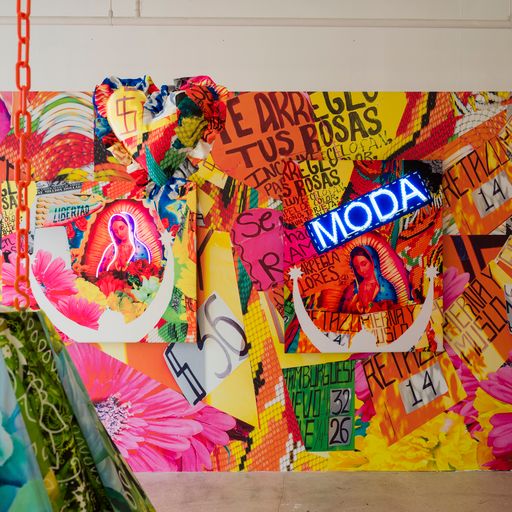
Images of the Virgin of Guadalupe juxtaposed with dollar bills are embedded in a colorful flower-filled pattern that spreads out across the gallery’s walls. The Virgin Mary reflects the unconditional love of mothers and symbolizes the epitome of womanhood in Latin American culture. Representing this love, large fluffy heart ornaments dangle from the ceiling, resembling the heart pillows a quinceanera kneels to pray on.
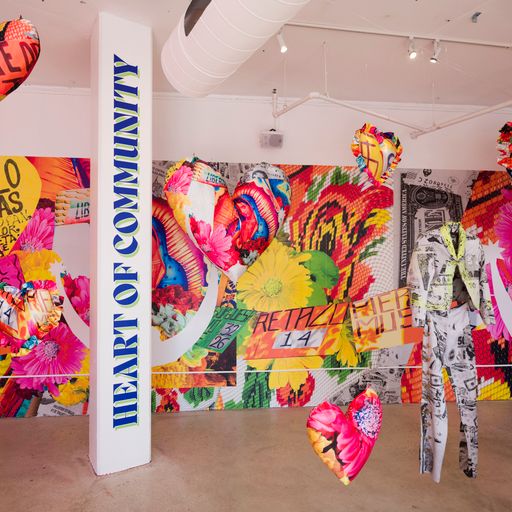
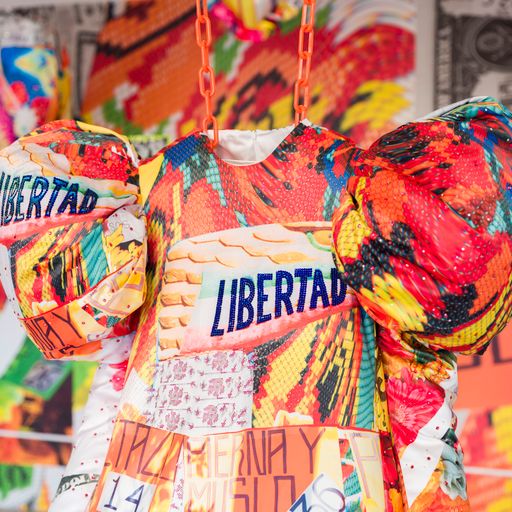
Wide-skirt dresses that fifteen-year-old Latin American girls wear at their traditional coming-out party are the exhibition’s centerpieces: flamboyant with rainbow-like hues and full of symbols like doll faces, the artist’s identification card and numbers like 14 and 66.
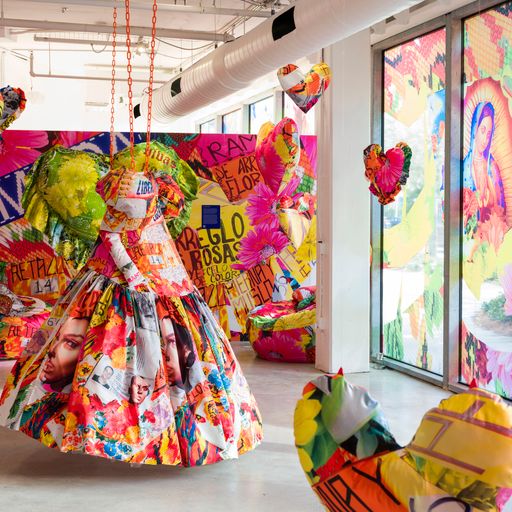
Inspirational words like Moda, Libertad, and Te Arreglo Las Rosas, sketched in black, pop out from the chromatic background, exuding the vibrant spirit of Latin American women.
In Heart of Community Argentine-born, Mexico-raised, Miami-based fashion designer and artist Anabella Bergero explores what it means to be a Latin woman through the experience of the quinceanera tradition. The latest display at the non-profit Project Room from Faena Art is immersive and interactive: a treat for all to see.
People from all walks of life can enter the vibrant project space, which is open to the public for free, and come alive through sharing their stories. “People come in and share their narratives. They complete the space with their own narratives. They share their own stories and grab pieces from the space to explore ideas. “It’s complete when the audience comes in,” explained Bergero.
The LatinX pop exhibition brings together fashion, art, and technology. It includes programming such as a tie-dye workshop with the Overtown Youth Center, the recording of a podcast, and a panel about art’s role in the community. On view until October 14, 2023, the multi-disciplinary showcase unites the community through immersive events.

But there is a more serious side to the multi-layered exhibition. It seeks to raise awareness about the plight of many Latin American women: liberty from oppression. A traditional mariachi suit with the name Machoriachi on the back accompanies the quinceanera gowns. It plays with notions of masculinity in Latin American culture, singing about the other side of Marianismo, Machismo. While Marianismo is associated with spirituality, chastity, nurturance, and self-sacrifice, Machismo is associated with commerce, sexual prowess, providing, and dominance. They keep people in mental boxes, uphold patriarchal structures and researchers claim they lead to psychological problems in both men and women.
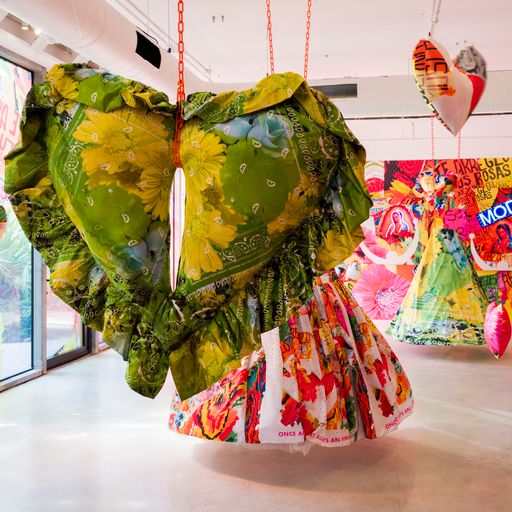
One of Bergero’s dangling pillow hearts is green to represent the Green Wave Movement, which started in Argentina and spread across to Mexico along with other parts of the world. The aim of the movement was to decriminalize abortions and provide reproductive rights to women. It helped deliver groundbreaking reforms in Latin America, providing safe abortions to women, and limiting the ability of medical professionals to refuse medical treatment on the grounds of personal, religious belief.

Bergero began to explore the construction of womanhood through the rite of passage quinceanera. “I went into my own history and that moment when I was becoming a woman. I had a forced quinceanera,” she proclaims. “It later inspired me to start researching the tradition.”
The dynamic artist studied in London and New York city where she expanded the identity that people form around cultural categories and aimed to demystify the stereotypes against Latinidad.
Working in a hybrid space of fashion and art, Bergero presented her ideas and concepts in fashion shows and art exhibitions. She delved further into art exhibitions in order to draw in a wider audience. “Whereas in fashion only few people can enjoy a run-way show, a lot more people can have access to an exhibition space that can go on for months,” she stated.
She didn’t see a lot of representation of Latin American culture in the mainstream art galleries in the United States, while on the streets, the culture is vibrant, especially in New York City. She started interviewing and photographing quinceaneras in Queens, a project which connected her to her roots in Mexico, where she grew up. She went back to Mexico and explored the quinceanera market, La Lagunita, where she shopped for her party when she was fifteen. She noted the symbols associated with the rite-of-passage, the crown and the shiny accessories, and explored their representations.

The artist’s exploration comes at a synchronous time in pop culture history with the release of the film Barbie, which explores the sexualization and oppression of women in a patriarchal society. Many Latin American girls were playing with Barbies at the age of their coming out party. At just fourteen girls, dressing up Barbies for makeshift fashion shows on runways made of shoe boxes, are prepared to display themselves as newly blossomed women. But many girls this age have no idea what it means to be a woman yet.
The girls dressed in wide-skirt princess dresses and tiaras seem to be prepped for marriage at a time when it’s the last thing on their mind. The girl’s budding womanhood is for sale as her prince must have the dollars to be worthy of her. In one image presented in the exhibition, a quinceanera stands next to her male counterpart, whose suit is adorned with dollar bills. The religious icon of unconditional motherly love, and the Marianiso of self-sacrifice it perpetuates, is married to the capitalist system that exploits women and the ensuing Machismo dominates it. The representations express religious idealism in Latin American countries like Mexico, impregnated with American consumerism- its riddles of exploitation.
“There is a danger in becoming a woman too,” the artist stated. At an early age, women are sexualized, objectified and commodified all over the world, which leads to violence. In some Latin American countries, femicide is an ongoing issue, which Bergero presents in the exhibition as well.
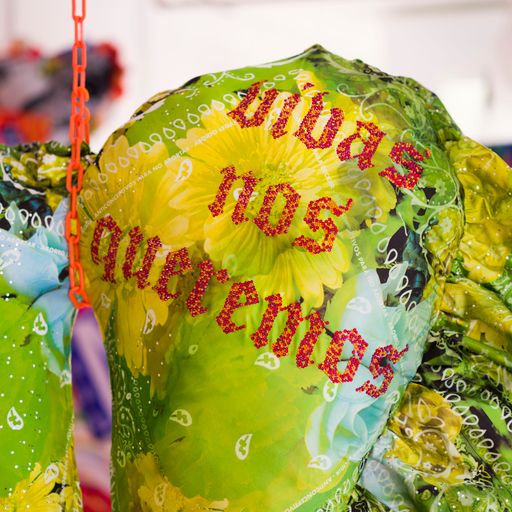
Vivas Nos Queremos We Want Ourselves Alive is a Latin American feminist slogan originating in Mexico City with the artistic activitst group Mujeres Grabando Resistencias. It is a unified cry for life, liberty, and freedom in the face of sexual violence.
All Hispanic women can relate to these ideas that are instilled in their culture through a shared iconography and universal experiences. The exhibition celebrates the rich tradition of Latin American women yet also brings the community together for healing and remembrance.
Photography by Oriol Tarridas
 Miami Chronicles