Written by Beth Braswell
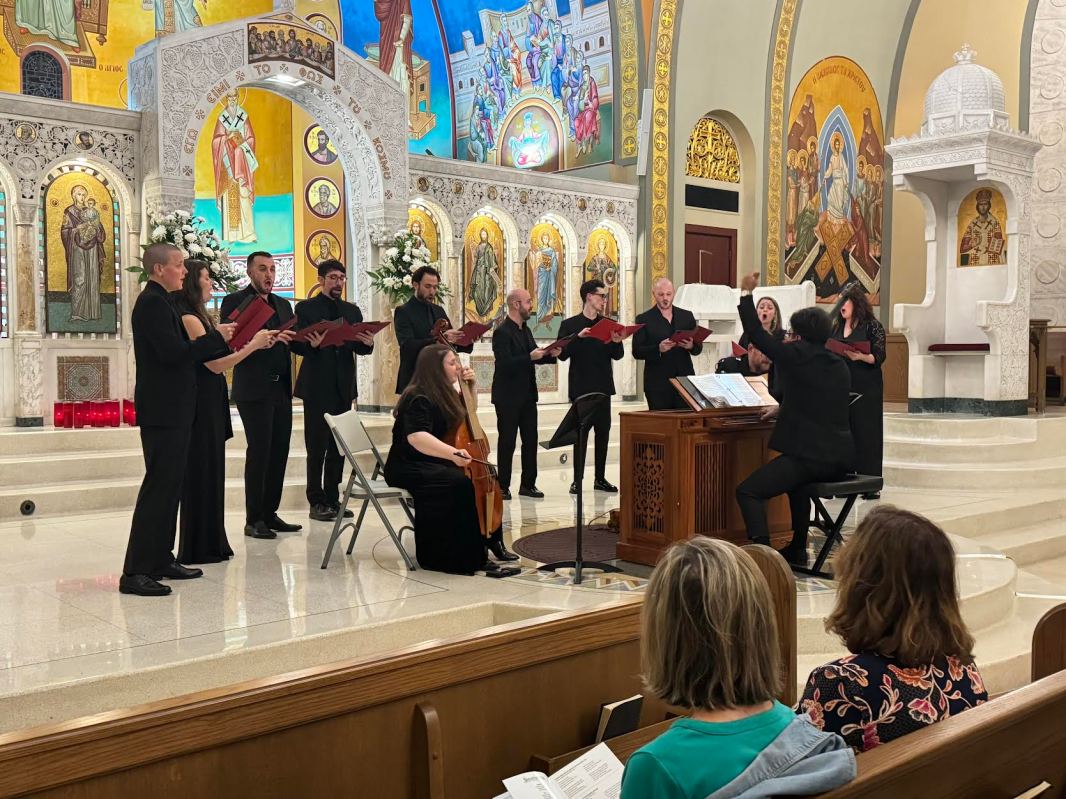
Seraphic Fire, known for their innovative take on classical compositions, is set to deliver a mesmerizing performance, delving into the compositions that mirror the post-World War II era.
Most people have heard the term ‘Mid-Century Modern’ and likely associate it with architecture and furniture design aesthetics. From the mid-1940s to the late 1960s, there was quite a dramatic pendulum swing away from the Victorian age which featured heavy woods, finials, and excessive ornamentation. The mid-century modern style focused on clean lines, lots of open space, little to no embellishments, and lots of glass and light for better integration with nature. Form should always follow function. There are many theories about the mental and emotional upheaval that transpired during World War II and how it influenced this dramatic shift in architecture and art. The war had engulfed the entire world with an unprecedented experience that left people with a different mindset about what was important in life; particularly excess and not needing it.
“Patrick [Patrick Dupre Quigley] called me and said, ‘I know you love mid-century modern, would you be interested in putting together a program’ Are you kidding me? Absolutely! I love the cleanness and simplicity of mid-century architecture and some of these musical selections follow that same aesthetic. Almost all of the pieces are ‘firsts’ for Seraphic Fire. The program is like looking through a microscope to see the radically changing cultural and social experience of classical music in the ‘50s and ‘60s. We were exploring space and about to go to the moon, and it was very forward-thinking environment.”
James K. Bass, conductor
Seraphic Fire’s Mid-Century Modern program features pieces composed between 1947 and 1974. There is another term important to know: the Age of Anxiety. The post-World War II era escalated in the 1950s when the real possibility of nuclear escalation was constantly at the forefront, with air-raid sirens being erected and nuclear bomb drills in schools.
Bass explains his musical selections: “Some of these musical arrangements in the program deal with that anxiety. One set, by African-American composers from 1952 – 1962, has a very different angle: expectant and hopeful. I put them on this program to show the diverse approach composers took in relating to the world situation around them.”
Two movements of a very famous set of pieces that Seraphic Fire has never previously performed are called “Carols of Death,” written right after the war in 1949 by William Schumann, a New York-based composer. He used text by the American poet Walt Whitman that portrayed his feelings about the devastation caused by the Civil War; emotionally similar to post-war eras. These are two amazingly deep introspectives about the meaning of life: To the Unknown Region and To All, to Each.
Equally self-reflective, the program features compositions by the amazing American composer, Samuel Barber. A composer from the age of 7, Barber had a gift for setting interesting text to emotionally moving music. Barber shared insights about his composing philosophy: “I can only say that I myself wrote always as I wished without a tremendous desire to find the latest thing possible.” Selected from his Opus 42, To be sung on the water features words from a poem by American Poet Laureate Louise Bogan. She studies how the transformation from abstraction to experience can occur. This moment is perfection – no matter what other aspirations we have or how tedious our lives may seem – these perfect moments are the fundamental reason for living, making time irrelevant.
Seraphic Fire artists will perform two pieces that are mid-century modern settings of ancient texts, and these same words have been set by many composers. The audience will get a rare opportunity to compare a 17th-century version of Weepe, O Mine Eyes to one arranged 300 years later.
“A very fascinating and surreal piece we will perform, Epitaph for Moonlight, explores interesting and new ways to notate music – how you actually write it,” said Bass. “Essentially the symbols and systems that we use as musicians have not really changed much in 800 years – the stems, the lines, the note heads – there’s been very little evolution. But, composers in the ‘50s and ‘60s decided to start using a method that could potentially elicit different types of sounds from singers. This graphic notation of symbols, dots, and shapes required the singer to follow the shape. The piece is read left to right, but it takes place mainly by counting time rather than by counting rhythm – so the singer would ‘do this for six seconds’ instead of here are six quarter notes.”
“Epitaph for Moonlight is the piece I am most excited about performing,” said Bass. He explained further: “This composer, R. Murray Schafer, also conducted a social experiment with seventh-grade children and asked them to write down sounds or words in a private language that made them think of moonlight. It was a completely different way of thinking about music. That coincides with architects of the time – what if we don’t put bricks on the outside of the house, what if we only use glass?”
When Schafer was asked about the title of his piece, he responded: “In 1969, American astronauts landed on the moon to the excitement of the whole world. But something died then. No longer would the moon be a luminous and mythogenic symbol; it threatened to become a piece of property covered with neon. That hasn’t happened yet, but in today’s polluted cities with their twenty-four-hour glare, no one even notices the moon anymore. The moon is dead. I saw her die.”
Performances:
Thu, Apr 25, 7:00 pm | Naples | Vanderbilt Presbyterian
Fri, Apr 26, 8:00 pm | Coral Gables |Church of the Little Flower
Sat, Apr 27, 7:30 pm | Ft. Lauderdale | All Saints Episcopal
Sun, Apr 28, 4:00 pm | Boca Raton | St. Gregory’s Episcopal
A Pre-Concert Conversation will be presented one hour prior to each performance.
Tickets and subscriptions are on sale now at SeraphicFire.org and by phone at 305.285.9060.
Venues:
Vanderbilt Presbyterian
Church of the Little Flower
All Saints Episcopal
St. Gregory’s Episcopal
 Miami Chronicles