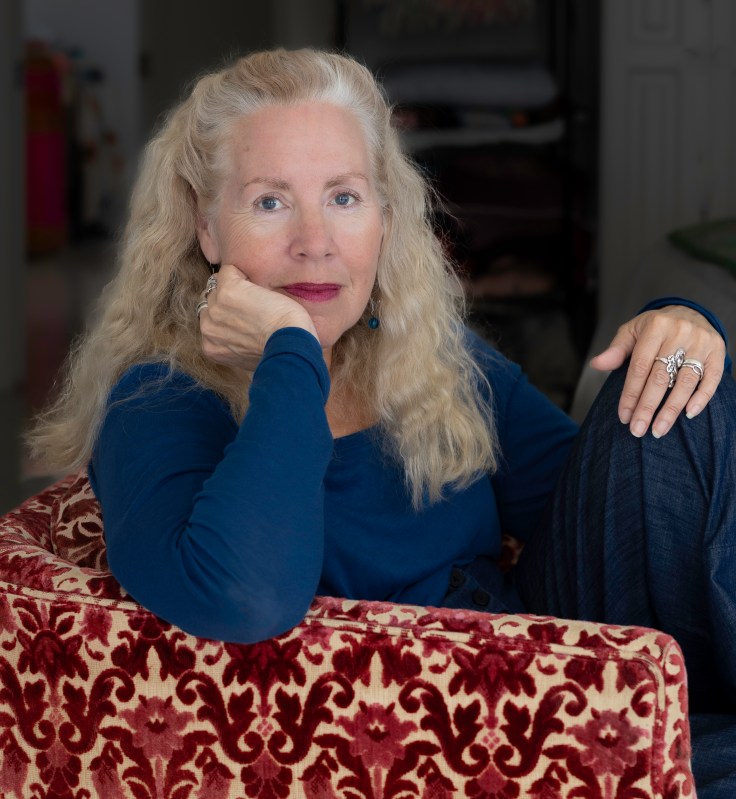
Denise Duhamel is a bona fide queen of her craft. In her latest and greatest book, Pink Lady, just released on January 16, 2025, Denise Duhamel pays homage to her mother. Through a collection of 62 poems, she interweaves her childhood, pop culture, religion, politics and her mother’s illness– and subsequent death– into a poetic blanket that encloses the reader with warmth and comfort.
Her memories take the reader through threads of the imagination into different undulations of thought spanning various timeliness and time frames. With a rich fabric of colors adorned with symbolism, she creates pieces that move the reader, especially since she’s dealing with universals themes of life and death. Written during the time of COVID-19, the deep felt poems blend the past with the present seamlessly connecting the difficult subject matter with a topical humor, which acts like a emollient, smoothing out the hard edges.

While the topics are often difficult, especially in poems like “Prodigal Prayer,” in which she recounts harrowing details of her mother’s illness, their gravity is lightened with humor. She uplifts the reader with a striking humor unique to her poetry. The playful touch of comedy imbues the collection with joy.
This is before I drive her twenty-year-old Toyota to see her
in the Catholic nursing home where the priest reminds us
“this too shall pass.” I will think about my mother passing
water, about her ultimate passing, her eventual death.
I question if her pain will indeed pass, if what is passing
through her body will keep on passing, looping into her,
the morphine drip not enough to dilute the pangs in her spine,
her neck, sciatic nerves running down both of her legs.
A chorus of nuns will sing while playing maracas
and tambourines. One sister will drop her percussion
as she falls asleep mid-song. It will be funny, then touching,
then ultimately so profound I become my mother
taking care of a two-year-old me. -from “Prodigal Prayer”
In an exclusive interview, Duhamel shared insights about Pink Lady, her writing process, and the lessons gleaned from transforming deeply personal experiences into art.
MC: What inspired you to write Pink Lady during such a deeply personal and challenging time?
DD: I felt so helpless much of the time. I could do nothing else useful but write. So many nights when my mother was ill, I had a lot of trouble sleeping so I would get up and write drafts of poems to document those times. I also kept a journal–more of rants and sadness than poems–but they gave me a timeline so I could remember the difficulties as I revisited those earlier journal entries.
MC: How did writing about your mother’s journey help you process those experiences?
DD: I often tell myself (and my students) that poetry is not therapy, but if I’m honest, I do think writing through difficult times is therapeutic. When I wrote down what was happening to my mother, the events of her life seemed more real to me. Facing my fears on the page was also quite helpful, creating some meaning out of all the chaos.
MC: You include many references to religion, particularly Catholicism, and spirituality, even mentioning angel numbers and signs. Do you feel that your mother’s death brought you closer to your spirituality or was it a way to honor her memory?
DD: That’s a great question, Monica. I think it might be a little bit of both. I grew up Catholic, but broke away from the church as a teenager mostly because of its treatment of women–original sin, and all that, which I just wasn’t buying. But my mother remained devout and being with her at her life’s end did make me feel a deeper spirituality. It wasn’t Catholicism necessarily, but I had much more of a sense of the way life and death are all part of one continuum. And like many people who have experienced loss, I received all kinds of signs after her death.
MC: You often infuse playful humor into your poetry. What role does humor play in balancing the heavy themes of illness and caregiving in your work?
DD: While caregiving and illness aren’t usually associated with humor, there is an intimacy and poignant hilarity as we humans adjust to strangeness that suddenly is the “new normal.” My mother fumbled with technology and only had a tracker phone because of her arthritis so we teased that she was a character in Breaking Bad. There were jokesters in the nursing home and the people who worked there were also quick to laugh in the face of their dangerous jobs.
MC: Many readers may find solace in your work. Did you think about your audience while writing, or was the process more introspective?
DD: I am so heartened to hear from many readers about their own experiences of loss during Covid-19. People who lost mothers, nanas, grandfathers, brothers, sisters, papas, spouses, cousins. The poems in Pink Lady about my mother are quite specific as I was trying to make her a real person, not just an archetypal mother. But the more specific you are as a poet the more universal you can become. There were over 1,200,000 Covid deaths in the United States alone. I knew my loss, as difficult as it was, was only one of millions of people who grieved.
MC: I find it fascinating how you blend the past with the present while also looking to the future in such a seamless and poetic manner. Can you comment on the importance of memory, especially when experiencing difficult yet universal life events?
DD. Yes! I found it important to remember my mother as a young person. She was so much more than just her illness in those last years of her life. And she was so much more than just my mother. She was a nurse, a daughter to her own mother, a sister, a friend to many people, a wife. And, of course, she was also once a child. I tried to weave those earlier events in as much as possible. Sometimes when you are living through a health ordeal, the present is hyper-present. So it’s important to look back too.
MC: What lessons from your childhood, reflected in the poems, have stayed with you as both a writer and a daughter?
DD: My mother was a caregiver for much of her life, as a nurse and also to me because I suffered from childhood asthma. I thought I took such a different path from her since I became a poet and an educator. But I realize now that caregiving or helping others manifests itself in so many ways. At the risk of sounding corny, I think it’s important to be there for others.
MC: What do you hope readers take away from Pink Lady?
DD: I hope Pink Lady serves as a document, covering those very difficult years of Covid-19 in a country seemingly unprepared for it. I hope it inspires empathy for the dignity of human life.
MC: Do you have any advice for others writing about deeply personal subjects, especially loss or illness?DD: Reading other poets’ work helps so you know you’re writing in a tradition or through community. When I was putting together Pink Lady I revisited several books with an elegiac mode which helped me access my own material. The books were Sharon Olds’ The Father, Kimiko Hahn’s The Unbearable Heart, and Kevin Young’s Book of Hours. Young also edited a wonderful anthology of elegies called The Art of Losing.
MC: What’s next for Denise Duhamel? Are there any current projects or themes you’re exploring in your writing now?
DD: I am in that fun and open space of writing individual poems but not sure how they will fit together yet. One of the themes I am exploring is the matriarchy. With our mother and all our aunts now passed, my sister and I realize we are now the matriarchy! It’s a daunting proposition and I don’t feel nearly as wise as my mother or the women who have come before me. But that in itself makes for interesting thinking and, with any luck, interesting poems.
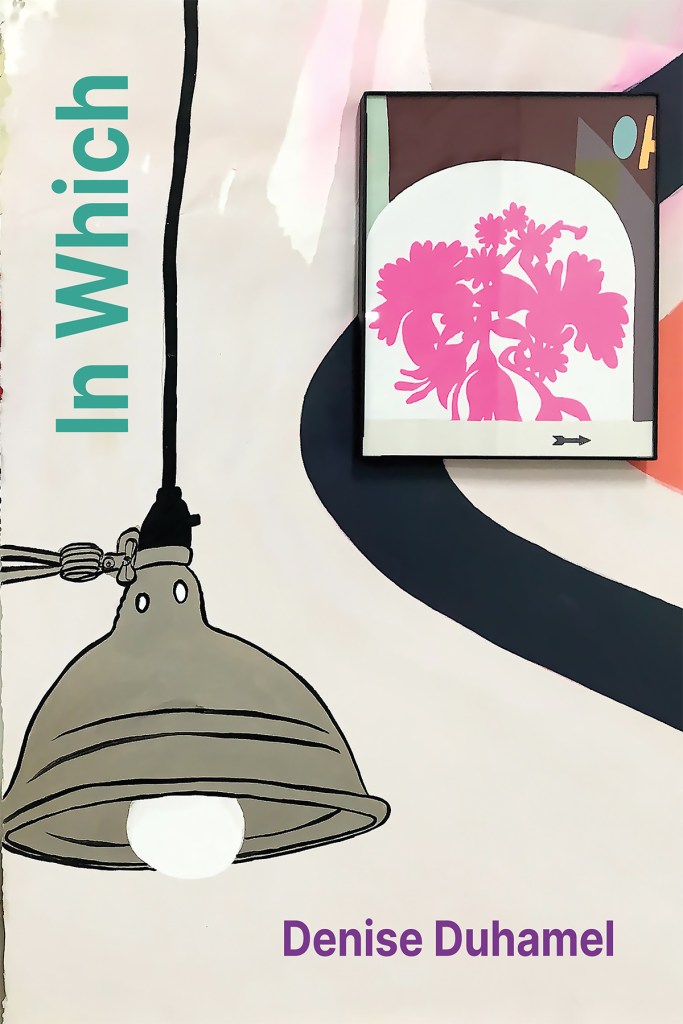
Denise is no stranger to playful poetry. Her recent chapbook titled In Which is a based on a fun, unique idea: the poet conjures up alternative universes for herself
All the poems start with the phrase “Poem in Which….”
I was blown away by the “Poem in Which My Speaker Is Bored with My Real Life.” In it, Denise sings throughout. While the lines do not always seem cohesive, somehow they blend on through like in the song “I Am the Walrus” from the Beatles.
“………Brig, a fiction student,
said I could use his image–the fluorescent light of lies.
He meant the ceilings of hospitals and the false promises
of enthusiastic doctors and nurses. He recently lost
his young wife. I, my mother. This boy will live, I told Brig.”
She infuses her characteristic absurdity in poems like “Poem in Which I Try to Be Social,” where she makes a play on social media’s mastubatory nature, which has replaced real interaction in today’s word.
“I hope you have enjoyed this poem!
For others, click on the links below.
I do my best to pound rhyme and rhythm
into this algorithm…………………….”
In others, she experiments with form, one of the funnest elements of Denise’s work. For example, in “Poem in Which I Contemplate Loneliness Through a Peephole,” she creates the shape of an eyeball with the line spacing.
Continuing with the playful nature of the verses she writes “Poem in Which Nick Helps Me Conjure More ‘In Which’ Poems,” in which she and her nephew toy with the concept of the chapbook.
When I tell him I’m working on “in which” poems
imagining alternative lives for myself,
my grandnephew Nick lights up–
What about a poem in which you are a dog?
In Pink Lady, she also explores different styles of poetry. In “My Mother in a Grass Skirt,” she uses tercets. In “Laundry Poem,” the words create a shape of a sideways triangle or flag on the page. Her humor reigns throughout her vibrant collections, giving readers a buoyancy of hope in the deep sea of loss.
Denise’s poetry only becomes deeper with each breath she takes underneath the raging waters of political and personal storms.
Check out Denise in person. She will be reading at the Betsy Hotel, tomorrow, Thursday January 30, 2025 from 7:00 PM-8:00PM. The event is called SSWIM: Poetry Reading and Conversation with Krysten Hill and Denise Duhamel
Denise Duhamel is a distinguished university professor in the MFA program at Florida International University in Miami. Her previous books include Second Story, Scald, Blowout, Ka-Ching!, Two and Two, and Queen for a Day: Selected and New Poems. She is a recipient of fellowships from the Guggenheim Foundation and the National Endowment for the Arts.
 Miami Chronicles